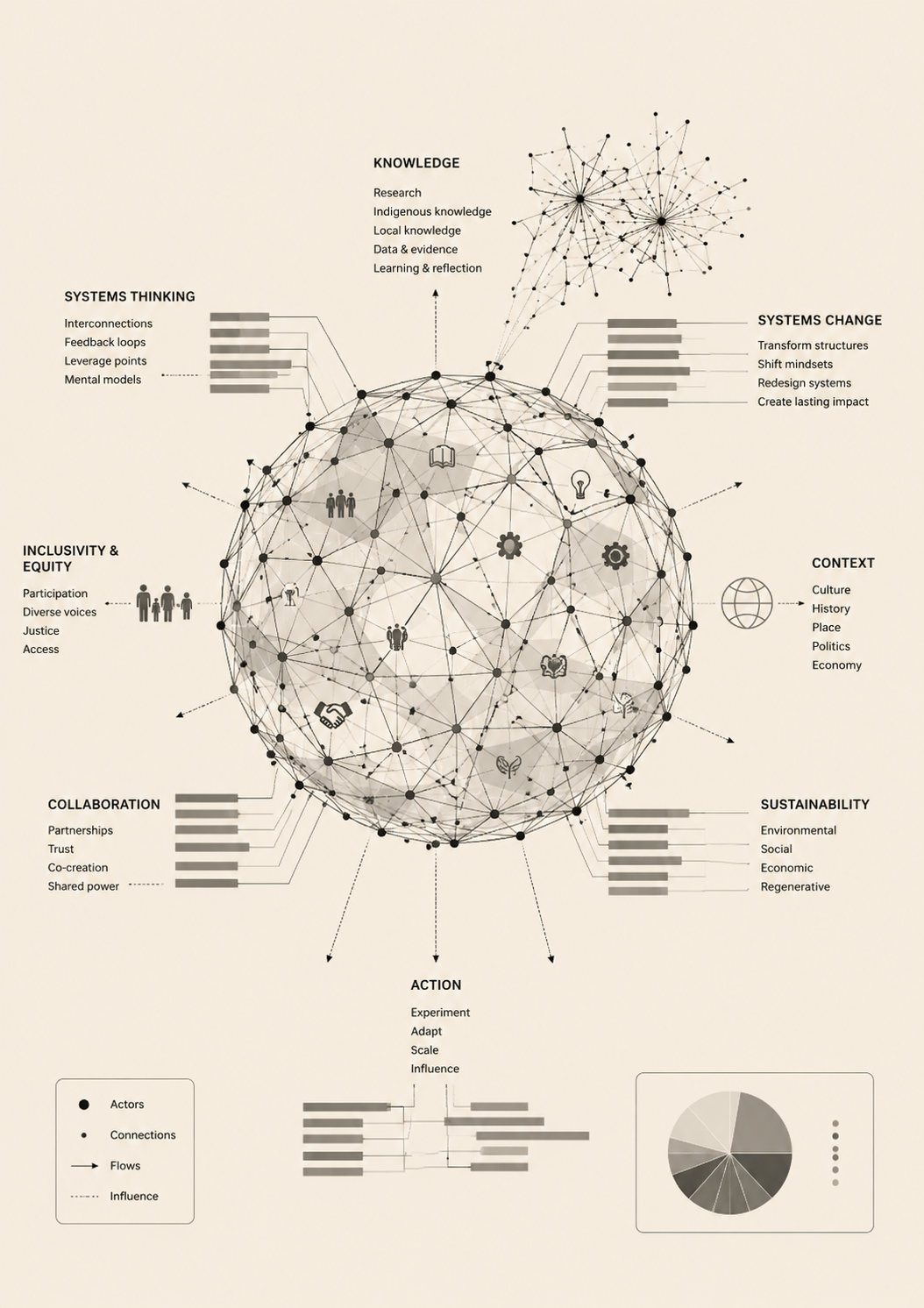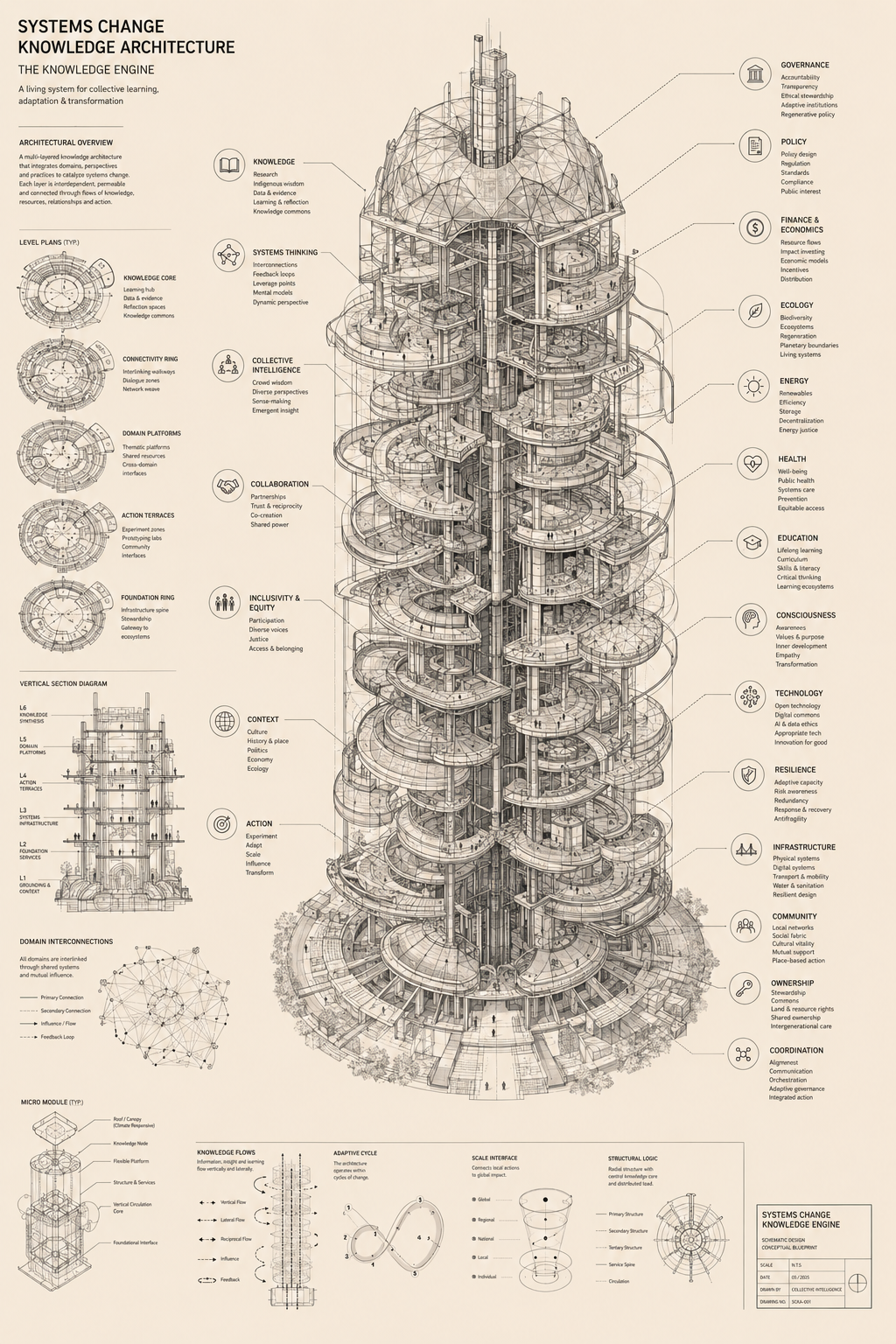
Systems-change knowledge is abundant but scattered across books, decks, recordings, expert calls and private documents. The Knowledge Commons turns scattered intelligence into navigable infrastructure.

Knowledge in this field lives everywhere and nowhere — in PDFs, CRMs, Notion pages, WhatsApp groups and personal networks. Abundant, but not navigable.
The Commons organises it into usable maps, frameworks, navigators and learning pathways — so a newcomer can stand on what the field already knows, and an expert's framework can become operational infrastructure rather than a forgotten document.
Because the Liaison System is human–AI, the layer shows responsibility and boundaries up front. AI accelerates coordination; it does not replace consent, trust or strategic judgement.
AI supports coordination. Humans retain judgement, consent, trust and responsibility.
The research beneath the layer — frameworks and working papers from Symviosis on how coordination infrastructure is measured, reasoned with, and shared.
Research brief. What to measure when building coordination infrastructure — the metrics a systems-change network should rally on, in what sequence, and the anti-gaming and immune-system defenses that protect it as it grows.
Read the paper →Whitepaper. Expert worldviews structured into living reasoning systems — AI-mediated expert proxies built from source material, claim indexes and worldview graphs, for higher fidelity than persona prompting and more judgement than a chatbot.
Read the paper →Working paper · WP-01. How a shared intelligence layer lifts financial safety, speed, margins and collective problem-solving — worked through a supply-chain cluster of five companies.
Read the paper →